




Can You Put a Sofa Cover on a Sofa Bed? A Fit and Safety Guide for Australian Homes
Yes, many sofa beds can use a protective cover while they are closed in sofa position, but the cover must be removed or safely repositioned before opening the bed unless the cover manufacturer specifically states that it can remain fitted. The correct option depends on the sofa-bed mechanism, cushion layout and whether you need a tailored replacement cover, a universal stretch cover, a throw or separate protective pieces.
Why sofa beds need a different cover decision
A normal sofa has one main shape. A sofa bed has at least two: a sitting position and a sleeping position. Some models unfold a mattress from inside the frame. Others slide forward, fold flat like a futon, pull out from beneath the seat or rearrange modular sections into a bed.
That movement changes where fabric can safely sit. A cover that looks neat while the sofa is closed may tighten across a hinge, bunch inside a track or become trapped when the bed is opened. Loose fabric can also obstruct handles, storage lids, legs or folding supports.
The safest general rule is simple: treat a universal sofa cover as a cover for the sofa configuration, not automatically as bedding or a permanent cover for the opened mechanism. Remove it before converting the sofa bed unless both the sofa-bed instructions and the cover instructions clearly permit another method.
Identify your sofa-bed mechanism first
“Sofa bed” is a broad label. Before measuring, open the furniture fully and identify what actually moves.
Pull-out mattress sofa bed
A traditional pull-out sofa bed stores a folded mattress and support frame beneath the seat cushions. The cushions are usually removed before a handle or frame is lifted and unfolded.
The main risks are fabric entering the folded frame, covering the pull handle or becoming trapped as the mechanism closes. A full stretch cover fitted over the complete sofa usually needs to be removed before the mattress is opened.
A throw or separate seat pieces may be easier because they can be lifted away quickly and stored while guests use the bed.
Click-clack or futon-style sofa bed
A click-clack sofa bed changes shape when the backrest folds down or the seat and back flatten into one sleeping surface. The upholstery itself usually remains part of the bed.
A tightly fitted universal cover may pull when the back changes angle. A loose throw can also slide or collect beneath the folding joint. Unless the cover is designed for that exact movement, remove it before conversion and use normal bed linen on the opened sleeping surface.
Slide-out or trundle sofa bed
Some sofa beds extend from beneath the seat. A lower platform, mattress section or drawer-like unit pulls forward and may rise to meet the seat.
Keep cover edges, tassels and straps clear of the lower track, wheels, lifting hardware and front panel. A draped throw that hangs near the floor should be removed before the lower section is pulled out.
Fold-out foam sofa bed
Compact foam sofa beds and chair beds unfold by rearranging padded sections. Because the seating surfaces become the mattress, an individual protective piece may need to be removed before sleeping unless it is specifically suitable as part of the bedding arrangement.
Measure every folded section rather than treating the product as a standard one-seater or two-seater sofa.
Modular sofa bed
A modular sofa may form a sleeping platform by moving an ottoman, chaise or armless section. There may be no internal metal mechanism, but separate modules still shift position.
Individual seat and back pieces or separate throws can be more practical than one large cover. They allow the modules to be rearranged without stretching fabric across joins.
Daybed with a pull-out or lift-up section
A daybed may have a trundle, storage base or lift-up platform. Make sure the cover does not obstruct access handles, lid movement or support hardware. A fitted mattress protector or model-specific upholstery cover may be more appropriate than a conventional sofa slipcover, depending on the design.
Sofa-bed cover options compared
| Cover option | Best use | Advantages | Main limitation |
|---|---|---|---|
| Model-specific replacement cover | Replacing removable upholstery on an identified sofa-bed model | Closest match to the original seams, openings and cushion shapes | Only fits the supported model and configuration |
| Custom-tailored cover | Complex or valuable sofa bed where a close fit is required | Can account for unusual arms, cushions and access points | Higher cost and professional measuring may be required |
| Universal stretch cover | Protecting a simple sofa-bed shape while it is closed | Fuller coverage and a fitted appearance | Usually must be removed before opening; not an exact replacement |
| Throw cover | Flexible daily protection and quick removal | Easy to lift off before converting the bed | Can move, drape into tracks or leave parts exposed |
| Individual seat or back pieces | Targeted protection on modular or removable sections | Easy to wash and remove section by section | Does not conceal the complete sofa |
| Sofa protector | High-contact zones used by pets, children or guests | Faster to remove than a full cover | Partial coverage and possible movement |
Replacement covers and protective covers are not the same
A replacement upholstery cover is made to attach to a particular sofa-bed frame and cushion set. It may use zips, hook-and-loop fasteners, ties or hidden openings positioned around the original mechanism. When properly verified, it can replace the removable factory upholstery.
A protective cover sits over the existing sofa. It may be universal, stretch-fitted, draped or supplied as individual pieces. It is chosen by measurements and shape rather than by assuming it duplicates the original cover.
This distinction matters because a protective cover should not be marketed as a permanent sofa-bed replacement unless its construction and compatibility have been verified. If the original cover has damaged zips, shaped corners or access openings, a model-specific or custom solution is usually more honest.
The same principle applies to the IKEA universal versus model-specific sofa-cover guide: model names and seat counts do not replace accurate compatibility checks.
How to measure a sofa bed for a cover
Measure the furniture closed and open. Use a flexible tape measure and record all dimensions in centimetres.
Sofa Decor’s sofa-cover measuring guide explains the core measurements for ordinary couches. Add the following sofa-bed checks.
1. Measure the sofa in its closed position
Record:
Overall width from outside arm to outside arm
Overall height
Total closed depth
Inside seat width
Seat depth
Back height
Arm width, height and length
Front apron or base height
Cushion width, depth and thickness
For a universal stretch cover, the closed dimensions usually determine whether the product can fit the sofa form.
2. Measure the fully opened footprint
Open the bed exactly as instructed by the manufacturer. Measure the total length and width of the opened furniture, including legs, platforms and extended sections.
It helps you understand which edges move and where clearance is required.
3. Identify handles and access points
Note the location of:
Pull handles
Fabric loops supplied with the furniture
Storage lids
Release levers
Folding legs
Mattress straps
Headrest or backrest joints
Wheels or tracks
Power controls on electric models
A protective cover must not hide or tighten around these areas.
4. Inspect the closing path
Watch the mechanism from the side while another adult operates it slowly. Identify where sections fold together and where hands, fabric or objects could be pinched.
Do not place fingers inside joints or reach beneath a moving frame.
5. Measure removable cushions separately
If the seat or back cushions must be removed to open the bed, measure each cushion. Individual pieces may protect those areas while allowing the main mechanism to remain uncovered.
6. Map modular sections
For modular sofa beds, draw the furniture from above. Mark the chaise, ottoman, corner, armless seat and any section that moves to create the sleeping platform.
This process follows the same module-by-module logic used in the guide to sofa covers for attached and fixed cushions.
Which cover format works best?
Universal stretch covers
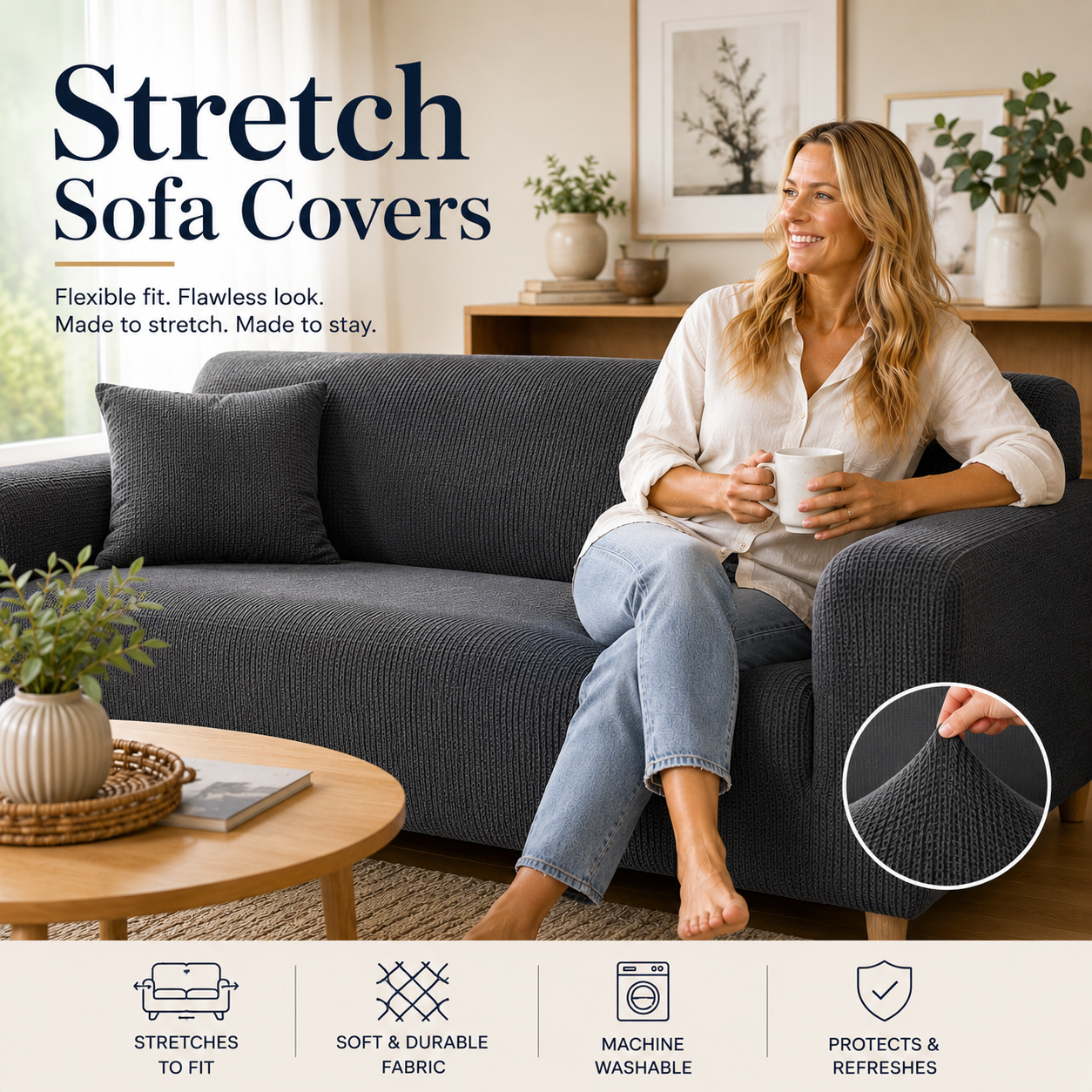
A stretch cover can give a conventional closed sofa bed a tidy, fuller-coverage appearance. It is most likely to work when the sofa has a simple rectangular form, conventional arms and safe tucking gaps.
Before ordering, confirm:
The closed dimensions fall within the live product range.
The cushion and arm shapes suit the cover.
The cover can be removed without excessive effort.
Straps or elastic will not sit near the pull-out frame.
The cover will be taken off before opening unless expressly approved otherwise.
Sofa Decor’s stretch sofa cover collection is the relevant format to compare, but the collection does not represent a model-specific sofa-bed compatibility promise.
Throw covers
A throw is often the most practical option for a guest-room sofa bed used mainly as a couch. It can protect the seat and back during daily use and be removed before guests open the bed.
Measure the complete drape you want, including the back height, seat depth and front drop. Avoid allowing long edges or tassels to sit near a trundle, wheel, hinge or pull-out frame.
Sofa Decor’s sofa throw cover collection provides flexible draped options. For example, the live Sofa Decor Solene Textured Chenille Sofa Throw Cover and Sofa Decor Oliva Leaf Fringe Sofa Throw Cover are throw-style products. They should be selected by their current sizes, product information and the area being covered—not treated as permanent covers for an operating mechanism.

Individual cover pieces
Individual seat, back or arm pieces can suit sofa beds whose cushions are removable or whose sleeping platform is formed by separate modules.
They are useful when:
One seat receives most daily wear.
The sofa has removable cushions.
The cover needs to be removed quickly.
The lounge converts by rearranging modules.
You want to protect the couch without enclosing the base.
Check whether each product is sold as one piece. Measure and count every required area before ordering.
Protector-style covers
A protector covers the highest-contact surfaces rather than the entire sofa. It may be suitable for pet fur, children’s snacks or routine guest-room use.
The live sofa protector collection is a relevant comparison path. A protector must still be removed if it could enter the mechanism or interfere with conversion.

Model-specific or custom covers
Choose a model-specific or custom cover when the sofa bed has shaped openings, removable factory upholstery, an unusual folding form or a finish that must look tailored.
This is particularly important when:
The cover needs to remain attached during conversion.
Access points must align precisely.
The sleeping surface forms from upholstered sections.
The original seams and cushion definition must be retained.
A universal cover would cross a hinge or track.
Safety rules when opening and closing a covered sofa bed
A sofa bed should be operated according to its manufacturer’s instructions. General cover advice cannot override those instructions.
Use the following conservative process:
Remove loose cushions, throws, protectors and universal covers unless they are specifically designed to remain in place.
Clear children, pets, bedding and nearby objects from the moving area.
Check that no fabric, strap, tassel or elastic is near the mechanism.
Use the supplied handle or intended operating point.
Open or close the bed slowly and evenly.
Stop immediately if the frame resists, sounds different or catches fabric.
Confirm that support legs or sections are fully deployed before placing weight on the bed.
Keep fingers away from hinges, folding frames and pinch points.
Do not force a partially obstructed mechanism.
Refit the protective sofa cover only after the furniture is fully closed and stable.
For powered sofa beds or sofa beds combined with recliner functions, also keep controls, leads, transformers and vents accessible. The recliner sofa-cover compatibility guide explains the additional precautions around powered and moving furniture.
Pets, children and guest-room use
A sofa bed in a spare room often becomes a second lounge, play area, home-office seat or favourite pet bed. That makes easy removal and cleaning more important than an elaborate fitted appearance.
For pet fur, a throw or individual piece may be easier to shake out, vacuum or wash according to the product instructions. For clawing or chewing, do not assume a cover is scratch-proof or damage-proof. It can reduce direct contact with the original upholstery but cannot guarantee protection against persistent behaviour.
For children, consider crumbs, shoes, craft materials and light drink spills. A water-resistant cover may slow the passage of a small spill when it is blotted promptly, but water resistant does not mean waterproof. Seams, edges and prolonged contact can still allow moisture through.
Before preparing the bed for a guest, remove the sofa cover, inspect the sleeping platform and use clean bedding appropriate to the mattress or sleeping surface. A decorative sofa throw is not automatically a fitted sheet, mattress protector or suitable sleeping layer.
Common sofa-bed cover mistakes
Measuring only the closed width
The width helps choose a cover, but it does not reveal the mechanism, moving path or opened footprint.
Leaving the cover on during conversion
Unless compatibility is specifically documented, remove the cover first. Fabric caught in a mechanism can damage the cover or obstruct the furniture.
Buying by “two-seater” or “three-seater” alone
Sofa beds with the same seat count can use entirely different frames, cushion layouts and mattress systems.
Hiding the pull handle
Do not tuck or stretch fabric over the intended operating point.
Letting a throw hang into a trundle path
Long drapes and tassels should be lifted away before a lower section moves.
Using a universal cover as bed linen
A sofa cover is designed for furniture protection. Use proper bedding on the opened sleeping surface.
Assuming water resistant means waterproof
Light-spill resistance is not a sealed liquid barrier. Clean spills promptly and follow the product care instructions.
Forcing a neat fit around a hinge
A visible gap is preferable to fabric entering moving hardware. If the cover cannot sit safely, choose a different format.
Pre-purchase compatibility checklist
Before choosing a sofa-bed cover, confirm:
I know the sofa-bed mechanism type.
I have read the furniture manufacturer’s operating instructions.
I measured the sofa closed and fully open.
I identified every hinge, track, handle, leg and moving section.
I measured removable cushions and modular pieces separately.
I know whether I want replacement upholstery or temporary protection.
I understand that a universal cover is not model-specific.
I can remove the cover before opening the bed.
No strap, tassel or edge will sit near the mechanism.
The product size and care instructions suit my sofa and household.
I am not treating a sofa cover as bedding or a mattress protector.
Any water-resistant claim is sufficient for light spills only.
I have checked the live return or exchange conditions.
Frequently asked questions
Can you put a sofa cover on a pull-out sofa bed?
Yes, a cover can protect the sofa while it is closed, but a universal cover should generally be removed before the mattress frame is unfolded unless it is specifically designed and approved to remain fitted.
Will a stretch sofa cover work on a click-clack sofa bed?
It may fit the closed sofa dimensions, but folding the backrest can place tension on the fabric. Remove the cover before changing positions unless the product instructions confirm compatibility with that movement.
What is the easiest cover for a sofa bed?
A removable throw or protector is often the easiest for occasional guest use because it can be lifted off quickly. The best choice still depends on the mechanism and the area requiring protection.
Can I sleep on top of a sofa cover?
A decorative or protective sofa cover is not automatically suitable as bed linen. Remove it and use proper sheets and any mattress protection recommended for the sleeping surface.
How do I cover a sofa bed with removable cushions?
Measure the frame and each cushion separately. Individual cushion pieces or a removable throw can provide targeted protection while remaining easy to remove before opening the bed.
Are Sofa Decor covers made specifically for sofa beds?
The verified collections linked in this guide offer universal protective formats selected by measurement and shape. They should not be treated as model-specific sofa-bed replacement covers unless an individual live product page expressly states that compatibility.
Can a water-resistant cover protect a sofa-bed mattress?
Do not rely on a sofa cover as mattress protection. Water-resistant sofa covers are intended for light everyday spills on covered furniture areas, not as sealed waterproof mattress protectors.
Choose a cover that is easy to remove and safe to live with
The best sofa cover for a sofa bed is not necessarily the tightest or most complete option. It is the cover that protects the closed sofa, suits the household and can be removed without interfering with the conversion mechanism.
Identify the sofa-bed type, measure it closed and open, and choose between a universal stretch cover, throw, individual pieces, protector or verified model-specific replacement. Keep all fabric away from hinges, tracks, handles and supports, and never force the furniture to operate around a cover.
Start with Sofa Decor’s complete sofa cover range, compare formats rather than model names, and use the live size and care information before ordering. When the mechanism or fit remains uncertain, a removable throw or a model-specific professional solution is usually the more responsible choice.