




Yes, you can use sofa covers on many couches with attached cushions, but the right format depends on which cushions are fixed and how much separation exists between the seat, back and arms. Full stretch covers usually work best when the sofa has clear tucking gaps. Throws are more forgiving on unusual shapes. Individual pieces suit exposed seat or back areas, while a custom or model-specific cover is the honest choice when a tailored fit is essential.
Key takeaways
- Identify whether the seat, back or both are fixed before choosing a cover.
- Use the sofa’s actual shape and tucking gaps—not seat count alone—to judge fit.
- Throws are often more forgiving; full stretch covers look neater only when the structure suits them.
- Choose custom or model-specific upholstery when a precise tailored result is essential.
Start by identifying your cushion configuration
“Attached cushions” can describe several different sofa designs. Before measuring or choosing a cover, press gently around the seat and back to work out which parts lift away and which are permanently connected to the frame.
Do not assume a cushion is removable because it has a visible seam. Some fixed cushions are sewn or upholstered into the sofa but still look like separate pieces. Others are connected by hidden fabric panels or zips intended for manufacturing rather than routine removal. Check the furniture care label or manufacturer’s instructions before attempting to detach anything.
Fixed-seat sofa
On a fixed-seat sofa, the seat cushion or padded seat deck cannot be lifted out. The surface may be one continuous bench or divided into shaped seating positions.
A full stretch cover can work when the cover is designed to wrap the whole sofa and there is enough space around the seat to tuck excess fabric safely. A throw can also sit over the seat and back without relying on cushion removal. Individual seat pieces may protect the top surface, but they will not enclose the cushion because it cannot be removed.
Fixed-back sofa
A fixed-back sofa has back cushions or a padded backrest attached to the frame. These may be tight and structured, or soft and pillow-like.
A stretch cover may follow a tight back more cleanly than a deeply padded or loosely filled attached back. Soft fixed cushions can compress under the cover, making the sofa look flatter than expected. A throw often preserves the original softness because it drapes over the shape rather than pulling it into a fitted outline.
Mixed fixed and removable cushions
Many sofas combine a fixed back with removable seat cushions, or a fixed seat with loose back cushions. This mixed layout gives you more options, but it also requires separate measurements.
For example, removable seat cushions may take individual cushion covers while the fixed back remains visible, or a full cover may wrap the frame before the loose seat cushions are placed back on top. The correct order depends on the product’s design and installation instructions.
Bench-seat sofa
A bench-seat sofa has one long seat cushion rather than two or three separate cushions. The bench may be removable or fixed.
A removable bench cushion can sometimes use one fitted cushion cover if its width, depth and thickness fall within the product’s size range. A fixed bench seat is usually better treated as part of the whole sofa, using a full stretch cover, throw or flat protective piece.
Fully removable cushions
When all seat and back cushions lift away, you have the greatest flexibility. You may use a full frame cover with separate cushion covers, individual pieces, or a throw. Removable cushions also make it easier to adjust fabric around the frame without compressing the cushion shape.
However, “fully removable” does not mean every universal cover will fit. Cushion thickness, piping, curved arms and frame proportions still matter.
Diagnostic table: which cover format suits your sofa?
| Sofa configuration | Full stretch cover | Throw cover | Individual pieces | Custom or model-specific cover |
|---|---|---|---|---|
| Fixed seat and fixed back | Possible if the shape is simple and tucking gaps exist | Often practical | Useful for surface protection only | Best for a tailored result |
| Fixed back, removable seats | Often suitable; separate seat covers may improve definition | Practical and easy to adjust | Good for removable seats and high-use areas | Useful for complex frames |
| Fixed seat, removable backs | Possible, but check how the cover meets the loose backs | Practical | Useful on the fixed seat surface and removable backs | Consider when back cushions are unusually shaped |
| Fixed bench seat | Suitable only when the cover can follow the full seat deck | Usually forgiving | Protects the top surface without enclosing it | Best for a close upholstered appearance |
| Removable bench cushion | Full cover or separate bench cover may work | Practical | One correctly sized piece may cover the bench | Useful for exact piping and shape |
| Fully removable cushions | Often the easiest layout for a fitted system | Works well | Strong option for targeted protection | Best when an exact replacement look is required |
The table is a starting point, not a guarantee. The actual result depends on the sofa’s dimensions, arm shape, tucking space, fabric friction and the cover’s construction.
Full stretch covers on attached cushions
A full stretch cover is designed to pull over the sofa and conform to its overall shape. It can create a cleaner, more fitted appearance than a throw, especially on a conventional sofa with distinct arms, back and seat.
Sofa Decor’s live stretch sofa cover collection is the relevant starting point for this format. Review the individual product page rather than relying on the seat count alone.
When a stretch cover is more likely to work
A stretch cover has a better chance of fitting neatly when:
The sofa has a conventional rectangular frame.
The arms and back are clearly defined.
There is a usable gap between the seat and back.
There are side gaps where the cover can be adjusted.
The fixed cushions are relatively firm.
The cover’s measurement range matches the sofa.
The fabric can be positioned without blocking a recliner, sofa-bed or electrical mechanism.
When the result may be less tidy
A universal stretch cover may struggle when the sofa has:
Deeply overstuffed attached back cushions.
Very shallow or absent tucking gaps.
Wide pillow-top arms.
A curved, sculptural or asymmetrical frame.
A fixed chaise attached to one side.
A low back with oversized cushions.
Buttons, controls or moving sections.
A slippery leather or faux-leather surface.
A stretch cover can also visually merge separate attached cushions into one shape. That may be acceptable when the goal is practical protection, but it will not reproduce the tailored seams of the original upholstery.
Throw covers: the forgiving option
A throw cover rests across the sofa rather than enclosing every contour. It is usually the simplest choice when attached cushions make a fitted cover difficult.
Throws suit fixed-seat and fixed-back sofas because they do not require each cushion to be removed. They can also be repositioned quickly and folded away when not needed.
The trade-off is movement. A throw may shift when people sit down, children climb onto the couch or pets repeatedly use one spot. The draped look is also more relaxed than a fitted slipcover.
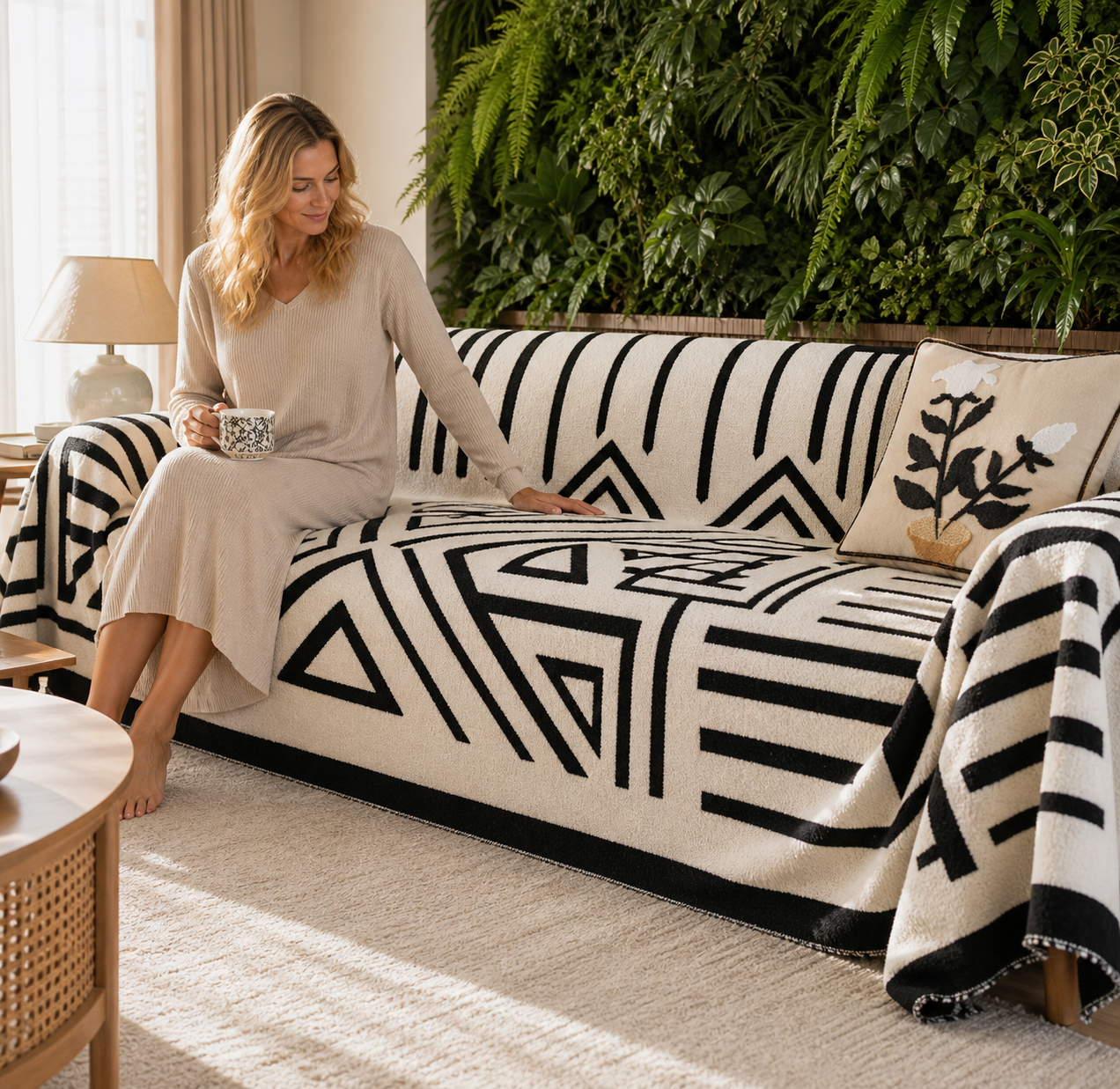
Sofa Decor’s sofa throw cover collection lets shoppers compare this format, while products such as the Sofa Decor Valencia Boho Jacquard Sofa Throw show how a throw sits across a lounge rather than replacing the original upholstery.
Choose the throw size by measuring the full area you want covered, including the seat depth, back height, arms and any drop you want at the front or sides. A throw that only matches the nominal number of seats may be too narrow for broad arms or a high back.
Individual seat, back and arm pieces
Individual pieces are useful when you want to protect high-contact areas without covering the whole couch. They can suit fixed cushions because the piece sits on top of the seat or back rather than wrapping around a removable insert.
Sofa Decor’s seat cushion covers versus full sofa covers guide explains the main format differences. The live product pages for the Alessia Woven Chenille Sofa Seat Cover, Hampton Plaid Jacquard Sofa Seat Cover and Arcadia Arch Line Sofa Seat Cover state that these products are sold as individual pieces rather than complete sofa sets.
That format gives you control over unusual proportions. You can choose separate pieces for a seat, backrest, arm or chaise area. It also means you must count and measure every area before ordering. One product unit should not be assumed to cover the entire sofa.
Individual pieces are less suitable when you want the original upholstery completely concealed or a continuous fitted appearance. Gaps between pieces may remain visible, and a piece placed on a rounded attached back may move unless its dimensions and surface grip are appropriate.
Compare live cover formats
Attached cushions rarely have one universal solution. These live product and collection paths show the main formats discussed in this guide.


When custom or model-specific covers are the better answer
A universal cover is designed to accommodate a range of sofas. It cannot reproduce every seam, curve, piping line or cushion division.
Choose a custom or model-specific cover when:
You require an upholstery-like tailored appearance.
The sofa has an unusual sculpted frame.
Fixed cushions have deep channels or complex shapes.
The original cover is removable and you want a true replacement.
Controls, mechanisms or built-in features require precise openings.
The sofa is valuable enough to justify professional measuring.
A loose or approximate fit would not meet your expectations.
Custom work usually costs more and may take longer, but it is often more honest than trying to force a universal product onto a shape it was not designed to follow.
How to measure a sofa with attached cushions
Use a flexible tape measure and record the dimensions in centimetres. Sofa Decor’s How to Measure for Sofa Covers guide covers the main frame measurements. For attached cushions, add the following checks.
1. Measure the outside frame
Record the overall width from outside arm to outside arm, overall height, total depth and front apron drop. Do not measure only the sitting area.
2. Measure the fixed seat surface
Measure the usable seat width and depth. If the seat is divided by seams, record both the total width and the width of each visible section.
For a bench seat, measure from the inside of one arm to the inside of the other. Record the deepest point if the front edge curves.
3. Measure the fixed back
Measure the backrest from the seat junction to the top edge. Record its width and maximum thickness. If it has three attached pillow sections, note each section even though they cannot be removed.
4. Measure available tucking gaps
With your fingers only, check whether a safe upholstery gap exists between the seat and back and beside the arms. Measure the approximate depth without forcing the tape into the sofa.
Do not push measuring tools, tuck sticks or fabric into hidden hardware. This is particularly important for sofa beds, recliners and powered furniture.
5. Measure loose cushions separately
For each removable cushion, record width, depth and thickness. Include piping and rounded edges in the maximum measurement.
6. Photograph the sofa
Take front, side and angled photographs. Include close views of attached cushion joins, arms and any mechanisms. These images are useful when asking a retailer or upholsterer about fit.
Why covers pull up, bunch or lose their shape
A cover that repeatedly moves is usually showing a compatibility or installation problem rather than simply needing more force.
There is nowhere safe to tuck the fabric
Fixed cushions sometimes meet the frame without a usable gap. When excess fabric cannot be positioned, it remains on the surface and bunches when someone sits down.
The cover is too small
An undersized stretch cover remains under constant tension. It may pull upwards from the front, flatten attached back cushions or slip away from the arms.
The cover is too large
Excess material can collect around the seat and create folds. Bigger is not always safer or neater.
The sofa has a low-friction surface
Leather and faux leather can allow covers to slide more readily than textured fabric. Sofa Decor’s guide to sofa covers for leather couches addresses the extra fit considerations for smooth upholstery.
The attached cushions change shape under pressure
Soft fixed cushions compress when someone sits down. The cover follows that movement and may not return to its original position without adjustment.
The wrong format was chosen
Tuck sticks or non-slip layers cannot turn an incompatible full cover into the correct format. A throw or individual pieces may be more practical on the same sofa.
Safe ways to improve the fit
Start by removing the cover and checking the measurements again. Reinstall it according to the product instructions, aligning the seams before stretching or tucking.
Distribute excess fabric evenly rather than forcing it into one gap. Smooth the cover from the centre of the seat towards the arms and back. On a suitable fixed sofa, approved foam inserts or tuck pieces may help maintain definition, but only when the product instructions permit them and there is no hidden mechanism.
A purpose-made non-slip underlay may reduce movement on some sofas. It must lie flat, remain concealed and be suitable for the upholstery surface. Check the sofa manufacturer’s care advice first, particularly for leather, coated fabrics and delicate finishes.
Do not use staples, nails, exposed safety pins, strong adhesives or improvised elastic cords. These can damage the upholstery, create sharp points or interfere with moving furniture. Keep all securing materials away from children and pets.
If the sofa reclines, converts into a bed or contains electrical components, review Sofa Decor’s stretch sofa cover fit problems and fixes and follow the furniture manufacturer’s instructions. A cover should never enter a hinge, track, motor or closing gap.
Compatibility checklist before you buy
Confirm each point before ordering:
I know which seat and back cushions are fixed or removable.
I have checked the furniture label or manufacturer’s instructions.
I measured the full outside frame, not only the seat.
I measured every removable cushion separately.
I recorded the fixed seat, fixed back and bench dimensions.
I checked whether safe tucking gaps exist.
I know whether I want fitted coverage, a relaxed throw or targeted pieces.
The product’s size range matches my actual measurements.
I understand that individual pieces are ordered separately.
I am not expecting a universal cover to reproduce tailored upholstery.
Any recliner, sofa-bed, USB or powered function will remain unobstructed.
The fabric and care instructions suit my household.
I have reviewed the exchange or return conditions before ordering.
Research sources
Secondary fit and measuring references used alongside Sofa Decor’s live product information:
Last reviewed 3 August 2026. All Sofa Decor links and imagery were verified live at publication. Product measurement ranges and care instructions take priority over general guidance.
Related sofa cover fit guides
For moving furniture, use our recliner sofa cover measuring and compatibility guide. If your sofa is an IKEA model, compare universal and model-specific sofa cover options.
Frequently asked questions
Can a stretch cover fit a couch with non-removable cushions?
It can when the sofa has a fairly conventional shape, suitable dimensions and enough safe tucking space. Deeply padded or unusually shaped attached cushions may produce a less defined fit.
Is a throw better than a fitted cover for fixed cushions?
A throw is usually more forgiving because it drapes over the attached cushions. A fitted cover may look neater when the sofa shape and tucking gaps suit the product.
Can I use individual seat covers on a fixed seat?
Yes, a flat individual piece can protect the seat surface, but it will not wrap around the fixed cushion like a removable cushion cover. Measure the exposed area carefully.
Why does my sofa cover keep pulling up at the front?
Common causes include an undersized cover, insufficient tucking space, soft cushions changing shape or a cover format that does not suit the sofa.
Can I detach cushions that appear to be sewn on?
Do not cut or detach them unless the furniture manufacturer confirms they are designed for removal. Visible zips or seams may be part of the manufacturing process.
Will a universal cover look like replacement upholstery?
Usually not. A universal cover can refresh and protect a sofa, but a model-specific or custom cover is the better choice for an exact seam-by-seam result.
What is the best option for a fixed-back sofa with removable seats?
A full frame cover combined with separate removable-seat covers can create more definition, provided the product is designed for that arrangement. A throw remains the simpler alternative.
Choose the format that works with the sofa
Sofa covers for attached cushions can work well when the format matches the actual construction of the couch. Begin by identifying fixed seats, fixed backs, mixed layouts and bench cushions. Then measure the frame, cushion surfaces and available gaps.
Choose a stretch cover for a conventional shape and closer fit, a throw for flexibility, individual pieces for targeted protection, or a custom solution when exact tailoring matters. The aim is not to force every sofa into the same cover. It is to choose a practical level of fit and coverage that the furniture can support.
Start with Sofa Decor’s full sofa cover collection, compare the available formats, and order only after matching the live size and product information to your measurements.