




Quick answer: Yes, you can cover many recliners, but the cover must suit the chair’s moving sections rather than treating it like a fixed sofa. A suitable recliner sofa cover should allow the backrest and footrest to move freely, keep controls and cables accessible, and fit each seat or module without loose fabric entering the mechanism. Measure the recliner in both upright and extended positions before ordering.
Key takeaways
-
Match the cover to the recliner mechanism and module layout, not only the total seat count.
-
Measure every moving seat, backrest, arm and footrest in both upright and fully extended positions.
-
Keep controls, cables, transformers, vents, hinges and pinch points completely clear.
-
Use separate pieces when seats recline independently or a centre console divides the lounge.
-
Treat water resistance and pet suitability as limited product claims, not guarantees.
Why recliners need a different approach
A standard couch stays in roughly the same shape all day. A recliner changes shape whenever the backrest lowers, the footrest rises or a lift mechanism tilts the chair. That movement changes where the fabric sits and how much tension is placed on the cover.
A cover that looks neat while the chair is upright may pull tight when the footrest opens. Extra fabric that seems harmless may drop behind the seat and sit near a linkage, motor, cable or hinge. A single oversized cover can also bridge across separate reclining seats and prevent them from moving independently.
The first decision is therefore not colour or fabric. It is whether the cover is compatible with the recliner’s layout and movement.
Before shopping, operate every function and note what moves. Check the backrest, footrest, headrest, lumbar section, arm controls, remote pocket, USB ports and centre console. For an electric recliner, also identify the power lead, transformer, motor area and any battery pack. The chair manufacturer’s instructions take priority over general cover advice.
Manual and electric recliners: what changes?
Manual and electric recliners perform a similar job, but they create different fitting and safety considerations.
Manual recliners
A manual recliner normally opens through a side lever, pull handle or body-pressure action. The cover must leave the handle accessible and must not tighten across the side panel when the footrest is released.
Watch the fabric while someone opens and closes the chair. If the cover pulls sharply around the lever, catches beneath the footrest or shifts into the side mechanism, stop and refit it. Do not cut an opening unless the product is designed to be altered; an unfinished cut can spread or weaken the cover.
Electric recliners
An electric recliner uses a motor to adjust one or more sections. Some models also include powered headrests, lumbar support, heating, massage, lighting, USB charging or lift-chair functions.
Keep the cover clear of switches, cables, plugs, vents and moving hardware. Never route a power lead through a tight fold in the cover or trap it beneath elastic, straps or furniture. Do not cover a transformer, battery pack or component that the recliner manufacturer says requires ventilation.
After installation, test the chair slowly while watching every moving edge. If the cover stretches hard, changes the sound of the mechanism, obstructs a button or moves towards a pinch point, remove it and reassess the fit.
Research note: Australian recliner guidance from La-Z-Boy Australia distinguishes powered controls and adjustable functions from manual mechanisms. For powered chairs, the ACCC Product Safety lithium-ion battery guide also supports keeping batteries, chargers and powered components undamaged, ventilated and used according to manufacturer instructions.
Identify your recliner layout before choosing a cover
“Three-seater recliner” is not a complete description. Two lounges with three visible seats can require entirely different cover systems.
| Recliner layout | Main fitting issue | Usually the better starting point |
|---|---|---|
| Single recliner chair | Footrest, side lever and back movement | Recliner-specific multi-piece cover or carefully fitted protector |
| Two-seat recliner | Seats may move independently | Separate cover set for each moving seat |
| Three-seat recliner | Centre seat may be fixed or reclining | Confirm the function of all three seats before ordering |
| Recliner with centre console | Console, cupholders and storage divide the seats | Separate left and right covers designed around the console |
| Modular reclining lounge | Modules, corner units and recliners have different dimensions | Measure and cover each module separately |
| Lift chair | Whole chair may tilt and rise | Manufacturer-approved solution or professional advice |
Single recliner chairs
A single chair is often easier to cover because there is only one moving seat. Even so, its back, arms, seat and footrest may need separate pieces. A conventional armchair slipcover is not automatically suitable.
Two- and three-seat recliners
Confirm whether each seat reclines independently. Some three-seat lounges have two reclining end seats and a fixed centre seat. Others contain three moving seats. A cover should not bind separate sections together.
Measure each seat bay, backrest and footrest, then compare those measurements with the product’s stated configuration. Do not rely only on the overall outside-arm width.
Centre-console recliners
A centre console changes the lounge into two distinct seating zones. The cover must not block cupholders, storage lids, charging ports or controls. A standard two-seater cover stretched across the console is generally a poor fit because it can obstruct access and interfere with independent movement.
Modular recliners
A modular reclining lounge may combine an armless recliner, corner unit, chaise, console and fixed seat. Treat every module as a separate furniture piece. Map the layout on paper and label each section before selecting cover sizes.
How to measure for recliner sofa covers Australia shoppers can use confidently
Use a flexible tape measure and record dimensions in centimetres. Measure the chair while upright first, then operate it and check how the dimensions and clearances change when fully extended.
For broader sofa-measuring principles, use Sofa Decor’s How to Measure for Sofa Covers guide. Recliners require several additional checks.
1. Measure the overall frame
Record:
-
Outside arm to outside arm
-
Overall height from floor to top of back
-
Overall depth while upright
-
Maximum depth while fully reclined
-
Clearance between the chair and wall
Overall width helps identify the general size category, but it does not confirm that a cover will suit the moving sections.
2. Measure each seat separately
Measure the usable seat width, seat depth and front drop. If two seats recline independently, record them individually even when they appear identical.
3. Measure each backrest
Record backrest width, height and thickness. Powered headrests or split back cushions may need independent movement, so check the dimensions in their normal and extended positions.
4. Measure the arms and control area
Measure arm length, width and height. Note the exact location of levers, buttons, USB ports, remote pockets and cupholders. A cover should provide access without pulling against the control panel.
5. Measure the footrest
Measure its width, length and thickness when open. Check the gap around the footrest as it closes. Fabric must not trail into the opening or become trapped between moving sections.
6. Photograph the recliner
Take clear front, side and rear photographs in both upright and reclined positions. Product names vary, so images often reveal compatibility issues that seat labels do not.
One-piece versus multi-piece recliner covers
One-piece covers
A one-piece cover can create a uniform look on a simple fixed sofa, but recliners are more demanding. One large cover may pull across the footrest, block controls or connect seats that need to move separately.
A one-piece option should only be used when the product is explicitly designed for the recliner’s configuration and its installation instructions preserve all moving clearances.
Multi-piece covers
Multi-piece systems commonly separate the back, seat, arms and footrest. This allows each section to move with less tension and makes it easier to wash a high-use piece without removing the entire set.
The trade-off is installation time. Each piece must be correctly identified, aligned and secured. A multi-piece cover can still fail if pieces are oversized, tucked into the mechanism or placed over controls.
Protector-style covers
A protector usually sits over high-contact zones rather than enclosing the whole chair. It can be practical when the upholstery still looks good and the main goal is to protect the seat, arms or pet area.
Sofa Decor’s guide to sofa protectors versus sofa covers explains the difference. On a recliner, reduced coverage can sometimes mean fewer points of conflict with moving hardware, provided the protector remains secure and clear of the footrest.
Choosing the fabric and protection level
The most suitable fabric depends on fit, household use and the product’s verified care instructions.
Stretch fabric
Stretch fabric can follow curved backs and padded arms, but it must not be stretched so tightly that it resists reclining. Check the product’s measurement range and whether it is designed as a recliner cover rather than a standard sofa slipcover.
Quilted or protector-style fabric
Quilted protectors can add a comfortable layer over high-use areas. Check how they are secured and whether straps or loose edges remain clear of controls and mechanisms.
Textured fabric
A textured finish may disguise small wrinkles and everyday marks better than a flat fabric. Texture does not, however, make a product claw-proof or suitable for every pet.
Water-resistant fabric
Water resistant is not the same as waterproof. A water-resistant cover may delay a light spill reaching the upholstery when the spill is cleaned promptly. It is not a sealed barrier, and liquid can still travel through seams, edges or prolonged contact.
Sofa Decor currently lists the Sofa Decor Nero Water Resistant Recliner Sofa Cover in one-, two- and three-seater variants. Its live page describes a stretch-fit, leather-look cover intended for light-spill resistance, everyday use and reduced movement when correctly installed.
It should not be treated as waterproof, scratch-proof or universally compatible. Compare your recliner’s measurements, controls and moving sections with the live product information before ordering.
Shop verified recliner-cover options
These live Sofa Decor options give readers a practical next step. Availability, variants, specifications and care information can change, so confirm the current product page and your measurements before purchasing.
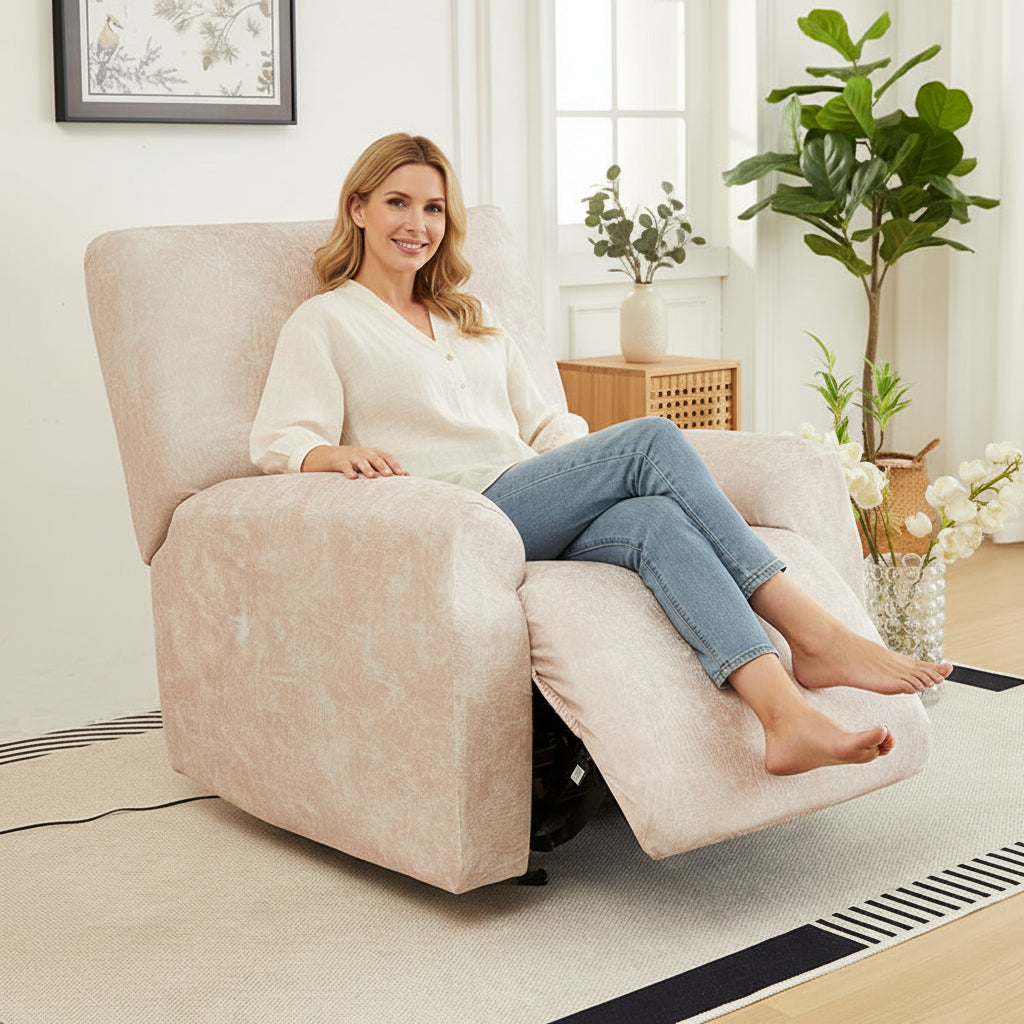


Recliner covers for homes with pets and children
For pets, focus on washable practicality, fur visibility and the animal’s behaviour. A cover can reduce direct contact with the original upholstery, but no ordinary fabric cover should be assumed to resist determined scratching, chewing or digging.
Choose a colour and texture that suit the pet’s hair and your cleaning routine. A removable seat or arm piece may be easier to maintain than a full cover when the pet uses one favourite section.
For children, consider snack spills, shoes, craft materials and repeated climbing. Water-resistant fabric may assist with small, promptly cleaned spills, but it does not remove the need for supervision or immediate cleaning.
Most importantly, do not let straps, elastic or loose fabric form loops near the footrest or controls. Test the recliner without children or pets nearby, and keep them clear whenever the mechanism is moving.
Sofa Decor’s pet-friendly sofa covers and water-resistant sofa covers provide broader product paths, but the recliner’s moving layout must still be checked before choosing any cover.
Installation mistakes to avoid
Tucking fabric into moving hardware
Tuck fabric only into safe upholstery gaps identified by the cover instructions. Do not push material into the metal mechanism, beneath the footrest or around electrical components.
Covering controls or cables
Buttons, levers, remote cords, power leads and USB ports must remain accessible and unobstructed.
Testing only in the upright position
A recliner cover is not fitted until it has been checked through its full range of movement.
Joining independent seats
Do not stretch one continuous cover across separately moving seats unless the cover was specifically designed for that exact layout.
Assuming a larger cover is safer
Excess fabric can bunch, shift and approach the mechanism. Larger is only useful when the product instructions allow the extra material to be safely tucked or draped.
Using grips to fix an incompatible cover
Tuck sticks and non-slip layers may reduce movement on suitable furniture, but they cannot make the wrong cover format compatible with a recliner. Never place an accessory where it can enter a moving gap.
For general installation advice, read How to Install a Sofa Cover in Under Five Minutes, while treating the recliner-specific cautions in this guide as the priority.
Pre-purchase recliner compatibility checklist
Before adding a recliner sofa cover to your cart, confirm:
-
I know whether the recliner is manual, electric or a lift chair.
-
I have identified every moving seat, backrest, headrest and footrest.
-
I measured each moving section, not only the overall width.
-
I checked the chair in upright and fully extended positions.
-
The cover is intended for my recliner configuration.
-
The cover will not bridge independently moving seats.
-
Side levers, buttons, remotes, consoles and cupholders remain accessible.
-
Power leads, transformers, battery packs and vents remain uncovered.
-
No loose fabric, strap or elastic can enter the mechanism.
-
The product’s water-resistance, pet and care claims meet my actual needs.
-
I have read both the recliner manufacturer’s instructions and the cover instructions.
-
I can return or exchange the cover if the measured fit is unsuitable.
If several answers are uncertain, contact the cover retailer with measurements and photographs before ordering.
Related sofa cover fit guides
Working with a different sofa layout? Read our guide to covers for attached cushions or compare universal and model-specific cover options for IKEA sofas.
Frequently asked questions
Can I put a normal sofa cover on a recliner?
Only when the cover is specifically suitable for the recliner’s shape and movement. A standard fixed-sofa cover may obstruct the footrest, controls or independently moving seats.
Do electric recliners need special covers?
They need covers that keep motors, switches, leads, vents and moving sections clear. Follow the chair manufacturer’s instructions and test all powered functions slowly after fitting.
How do I measure a three-seat recliner?
Measure the overall frame, then measure each seat, backrest and footrest separately. Confirm which seats recline and whether the centre section is fixed, powered or a console.
Can a cover go over a recliner console?
Do not cover a console unless the product is designed to do so without blocking storage, cupholders, charging ports or controls. Separate left and right seat covers are usually more practical.
Will a recliner cover stop pet scratches?
Do not assume so. Pet-friendly means useful for pet households, not scratch-proof. Consider the pet’s behaviour and keep claws maintained.
Is a water-resistant recliner cover waterproof?
No. Water-resistant fabric may help with light spills that are cleaned promptly, but it is not a sealed barrier and should not be exposed to soaking.
What should I do if the cover catches when reclining?
Stop using the mechanism, return the chair to a safe position if possible and remove the cover. Do not continue operating the recliner until the obstruction has been resolved.
Choose compatibility before appearance
The best recliner sofa cover is one that works with the furniture rather than fighting it. Identify the mechanism, map each moving section, measure the chair upright and extended, and keep controls, cables and footrests clear.
Once compatibility is established, compare colour, texture, cleaning and protection. Start with Sofa Decor’s sofa-cover fit comparison chart and the live recliner-cover information, then choose only when the measurements and movement requirements align.
A restrained, well-fitted cover will look better and be safer to use than an oversized cover forced onto the wrong recliner.
Research sources
This guide combines Sofa Decor’s live measurement, installation, fit and product information with manufacturer and Australian product-safety guidance. Sources were checked on 3 August 2026:
Last reviewed: 3 August 2026. Product availability, specifications and manufacturer guidance may change; check the linked pages before ordering or fitting a cover.