




How to Choose an Armchair Cover: A Fit Guide for Tub, Wingback, Barrel and Swivel Chairs
The right armchair cover depends on the chair’s shape, not simply the fact that it seats one person. A universal stretch cover may suit a compact club or barrel chair, while a wingback, high-back, exposed-leg or swivel chair may require a different format. Measure the full back, seat, arms and base, then check whether the cover is designed for that specific chair shape before ordering.
Why “one-seater” is not enough information
Two chairs can both be described as one-seater armchairs while having almost nothing else in common.
One may be a low, rounded tub chair with the arms and back forming a continuous curve. Another may be a tall wingback chair with projecting side wings, a loose seat cushion and exposed timber legs. A third may rotate on a central swivel base.
Those differences determine whether a cover can follow the chair’s shape, where excess fabric can be positioned and whether any part of the chair must remain clear.
The seat count is useful for browsing, but it is not a fit specification. Before choosing among armchair covers in Australia, identify the chair type and decide what result you need:
A fitted cover over most of the chair
A removable layer over the seat and back
Protection only on high-contact areas
A true replacement for removable upholstery
A tailored cover that preserves the original silhouette
A universal cover can refresh many ordinary chairs, but it cannot reproduce every curve, wing, seam, leg opening or swivel-base clearance.
Identify your armchair shape
Standard upholstered armchair
A standard armchair usually has a defined seat, separate arms and a medium-height back. It may look like a compact version of a conventional sofa.
This is generally the easiest armchair type to cover. A compatible one-seater stretch cover can work when the chair has a straightforward shape, covered arms and usable gaps around the seat.
Check whether the seat cushion is fixed or removable. A removable cushion may be covered separately, while a fixed seat must be treated as part of the main chair.
Club chair
A club chair is typically broad and upholstered, with substantial arms and a relatively deep seat. The back may be straight or gently curved.
Club chairs can suit a stretch slipcover when the arms, back and seat fall within the product’s measurement range. Broad arms use more fabric than narrow arms, so outside width alone does not tell you whether the cover will sit correctly.
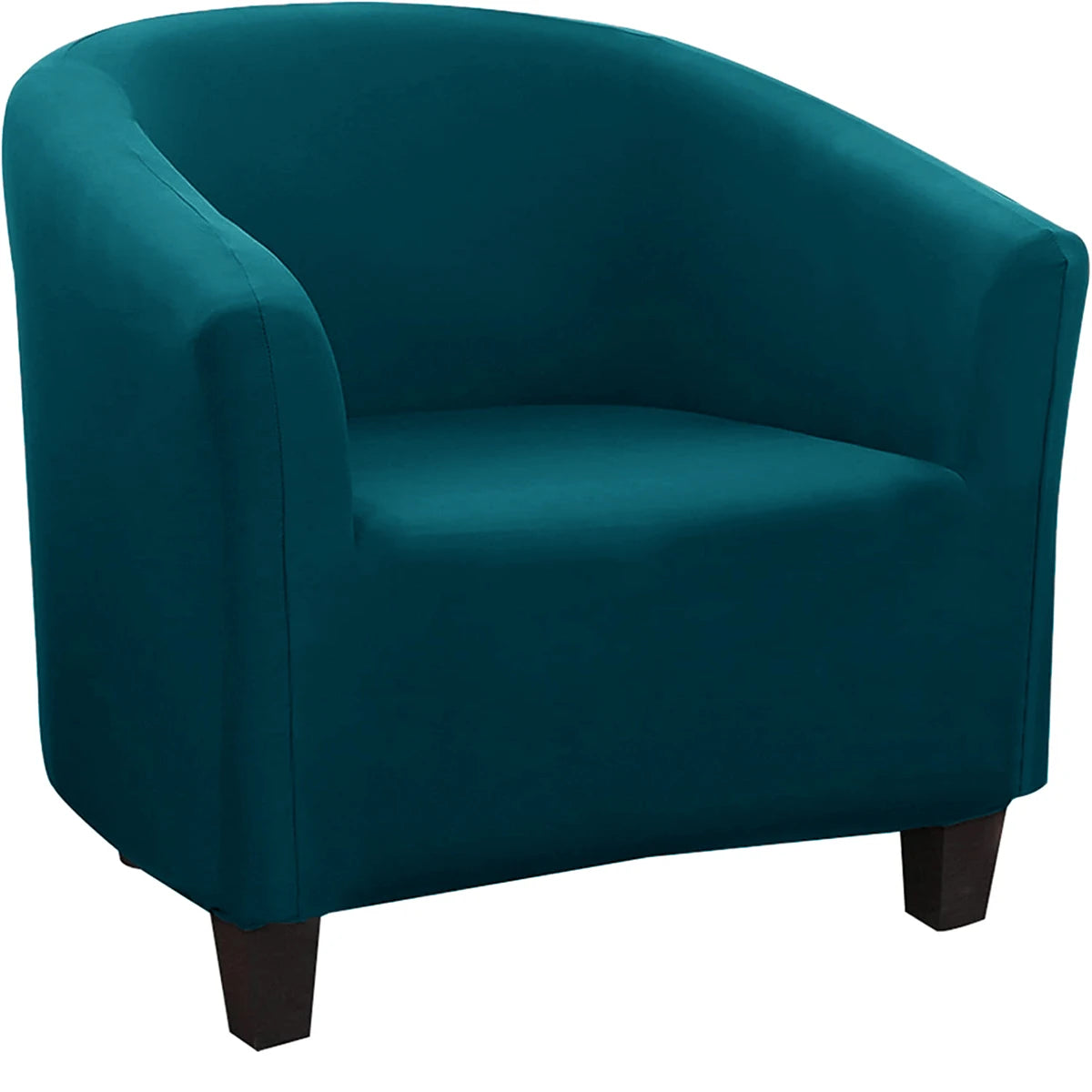
Sofa Decor’s live Monaco Stretch Club Chair Slipcover is specifically presented as a single-seat stretch cover for club or barrel-style chairs. That does not make it compatible with every armchair. Compare the current product measurements and images with the actual chair before ordering.
Tub chair
A tub chair has a curved back that usually flows into the arms, creating a compact enclosed shape. Some designs are low and rounded; others are taller or more angular.
The continuous curve can suit a highly elastic cover designed for tub or barrel chairs. A standard one-seater sofa cover may leave excess fabric at the back or pull awkwardly where separate arms would normally be expected.
Pay close attention to:
The widest point across the curved back
The inside seat width
Back height
Overall chair height
Seat depth
Whether the base is upholstered or exposed
Barrel chair
A barrel chair is similar to a tub chair but often has a more pronounced rounded back. The back and arms may form almost a complete semicircle around the seat.
A barrel cover must stretch around the outer curve without pulling the chair’s padding out of shape. Measure the outside circumference-related width at the broadest point rather than using only the narrow seat width.
Some products use “tub”, “barrel” and “club” loosely. Always compare the product photographs and size information rather than relying on the label.
Wingback chair
A wingback chair has a tall back with side projections, or “wings”, near the head and shoulders. The arms may be rolled, straight or narrow, and the seat cushion may be removable.
Wingback chairs are difficult to cover with a generic one-seater slipcover because the wings create additional width and shape changes near the top. A standard stretch cover may flatten the wing profile, pull away below the wings or create excess fabric around the arms.
A product must specifically accommodate the winged shape if a close fit is expected. Where exact wing definition matters, a wingback-specific or tailored cover is usually the more honest choice.
A throw or individual pieces can provide practical protection without trying to enclose the complete chair.
High-back reading chair
A high-back armchair may resemble a wingback chair but without pronounced side wings. It can have a straight, curved or tapered back.
Measure the full back height from the seat junction to the highest point. Many ordinary one-seater covers are designed around lower lounge-chair proportions and may not provide enough fabric for a tall back.
Check whether pulling a cover over the back would restrict a removable head cushion, lumbar cushion or decorative top edge.
Accent or occasional chair
An accent chair may have exposed timber or metal arms, an open frame, a separate upholstered shell or an unusually sculptural shape.
A full universal cover is often unsuitable because it may hide the frame, hang through open sections or have nowhere secure to sit. Individual seat and back pieces can be more practical when the upholstered areas are clearly separated.
For valuable designer or vintage accent chairs, professional upholstery advice may be more appropriate than forcing a universal cover onto the form.
Swivel chair
A swivel chair rotates on a central base or concealed mechanism. Some swivel chairs also rock, tilt or recline.
A cover must remain above and clear of the rotating base. Fabric, elastic, ties and long edges should not hang into the swivel mechanism or drag on the floor.
Test the chair through a full rotation after fitting the cover. Remove the cover if it twists, tightens, catches or follows the base movement.
A swivel recliner should be treated primarily as a moving recliner, using the more cautious process in Sofa Decor’s recliner sofa-cover guide.
Armchair-cover formats compared
| Cover format | Best suited to | Main advantage | Main limitation |
|---|---|---|---|
| Shape-specific stretch slipcover | Compatible club, tub or barrel chairs | Covers most upholstery and creates a fitted appearance | Must match the chair’s proportions and shape |
| Standard one-seater stretch cover | Conventional sofa-style armchairs | Broad coverage on simple forms | Often unsuitable for wings, exposed frames or unusual curves |
| Throw cover | High-back chairs, unusual shapes and temporary protection | Flexible and easy to remove | Can move and may not cover the sides or lower frame |
| Individual seat, back and arm pieces | Accent chairs, modular coverage and high-use zones | Each upholstered area can be measured separately | Does not produce one continuous fitted appearance |
| Protector-style cover | Everyday seat and arm protection | Quick to fit, remove and clean | Partial coverage and possible movement |
| Model-specific replacement cover | Identified chairs with removable original upholstery | Closest match to factory seams and openings | Only suits the supported model and version |
| Custom-tailored cover | Valuable, vintage or unusually shaped chairs | Can preserve the chair’s design and proportions | More expensive and requires accurate professional measuring |
How to measure an armchair for a cover
Use a flexible tape measure and record every measurement in centimetres. Do not rely on the chair’s retail category or estimated seat count.
Sofa Decor’s How to Measure for Sofa Covers guide provides the general framework. For armchairs, record the following dimensions.
1. Overall outside width
Measure across the widest point of the chair. This may be:
The outside edges of the arms
The curved back of a barrel chair
The wings of a wingback chair
A padded upper section wider than the base
Do not assume that the arms are the widest part.
2. Inside seat width
Measure the usable sitting area between the inner arms. A chair with broad arms may have a much narrower seat than another chair with the same overall width.
3. Seat depth
Measure from the front edge of the sitting surface to the point where it meets the back cushion or backrest.
For a loose seat cushion, measure the cushion separately, including its maximum thickness.
4. Overall back height
Measure from the floor to the highest point, then measure from the seat junction to the top of the back.
The first measurement shows the overall chair proportions. The second indicates how much cover fabric must travel over the upholstered back.
5. Back width
Measure the back at its widest point. For a tapered chair, also record the width near the seat and near the top.
For a wingback chair, measure across the outer edges of both wings.
6. Arm dimensions
Measure:
Outside arm height
Inside arm height
Arm width
Arm length from front to back
Distance between the arms
Rolled or pillow-top arms require more fabric than slim straight arms.
7. Base and leg clearance
Record the height from the floor to the upholstered base. Check whether the legs are exposed and whether you want them to remain visible.
For swivel chairs, identify the full rotating base and leave it uncovered.
8. Fixed and removable sections
Note whether the seat cushion, back cushion or arm pads can be removed. Sofa Decor’s guide to sofa covers for attached cushions explains how fixed and removable sections change the available cover formats.
9. Photograph the chair
Take clear photographs from:
The front
Both sides
The back
Above the seat
Beneath the chair, where safe
The base and any moving components
Images can expose shape differences that a list of measurements does not capture.
Choosing a stretch armchair cover
Stretch covers work best when they are designed for the chair’s general form and the measurements fall within the stated range.
A stretch cover is more likely to sit well when:
The chair is fully upholstered.
The arms and back form a predictable shape.
There is a clear seat junction.
There are safe gaps for positioning excess fabric.
The seat is not dramatically wider or narrower than the upper back.
The chair does not have an exposed frame.
The base does not rotate, rock or move beneath the fabric.
Do not deliberately choose an undersized cover to obtain a tighter result. Excessive tension can pull seams out of alignment, flatten padding and cause the cover to lift from the seat.
An oversized cover is not automatically better. Extra fabric may gather at the base, obscure the legs or move during normal use.
The live Monaco product is a relevant option to compare for a compatible club or barrel-style chair. It should not be described as a wingback, swivel, recliner or universal accent-chair solution unless the live product information explicitly confirms that use.
Using separate pieces on an armchair
Separate pieces can be a strong option when the chair has an unusual frame or when only the seat, back or arms require protection.
Sofa Decor’s Piece-by-Piece Sofa Cover Sizing Guide recommends treating the chair as separate cover zones. A common armchair plan may include:
One seat piece
One back piece
Two side-rest or arm pieces
The precise set depends on the product family and the chair’s measurements.
Sofa Decor’s live Aria Textured Armchair Sofa Cover Pieces are sold in separate seat, back and side-rest formats. These pieces provide targeted coverage rather than one complete fitted chair cover.
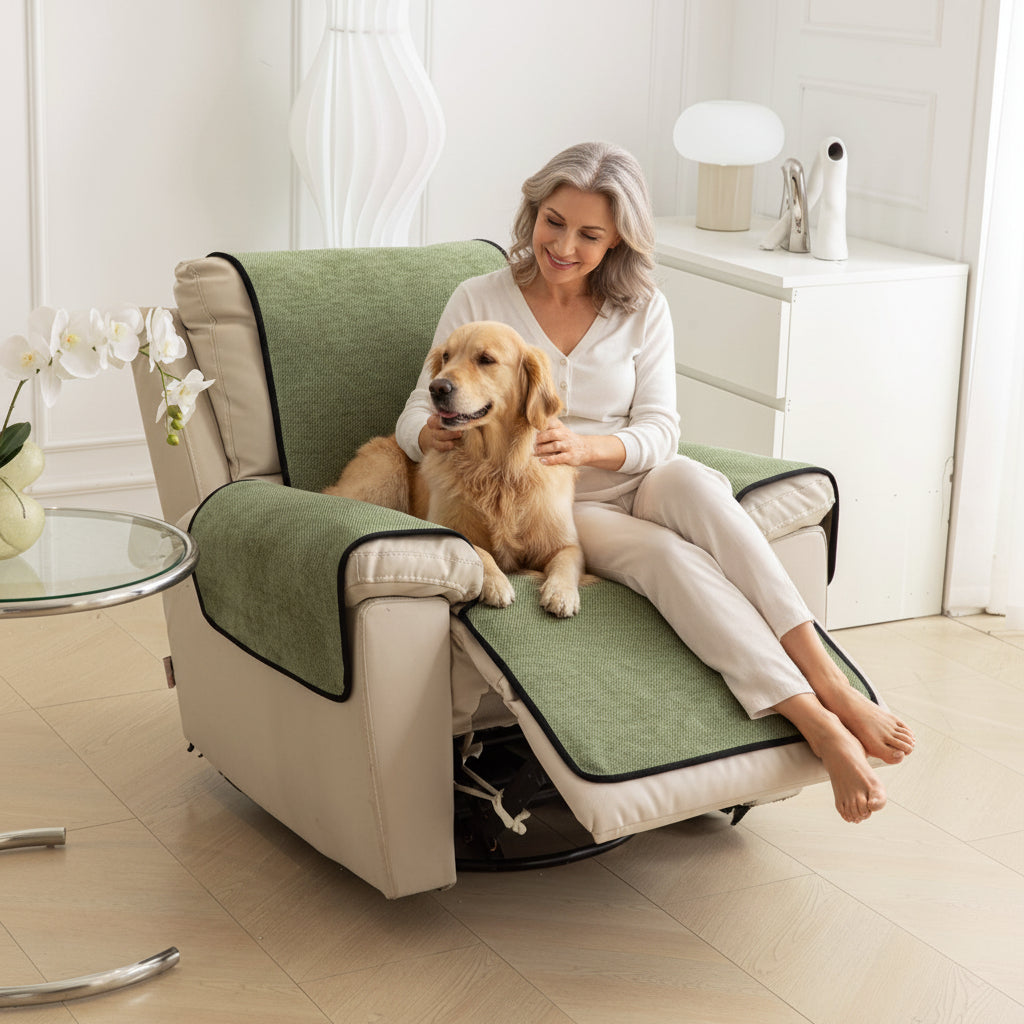
This approach is useful for:
Exposed-frame accent chairs
Wide armchairs
High-back chairs
Reading chairs
Chairs where pets use one favourite area
Chairs with worn arms but an otherwise presentable body
Mixed fixed and removable cushions
Measure and order each required piece separately. Do not assume one unit covers the entire armchair.
Throws and protectors for difficult chair shapes
A throw can be the most practical answer when a fitted cover would fight the chair’s structure.
A high-back chair can use a long throw across the back and seat. A wingback chair can be protected through the centre without flattening the wings. An accent chair with timber arms can keep the frame visible while the upholstered surfaces receive some coverage.
The limitations are movement and incomplete coverage. A throw may need repositioning after sitting and may leave the outer back, arms or lower seat exposed.
Avoid excessively long drapes on swivel or rocking chairs. Keep fringes and edges clear of the base, floor and any moving joint.
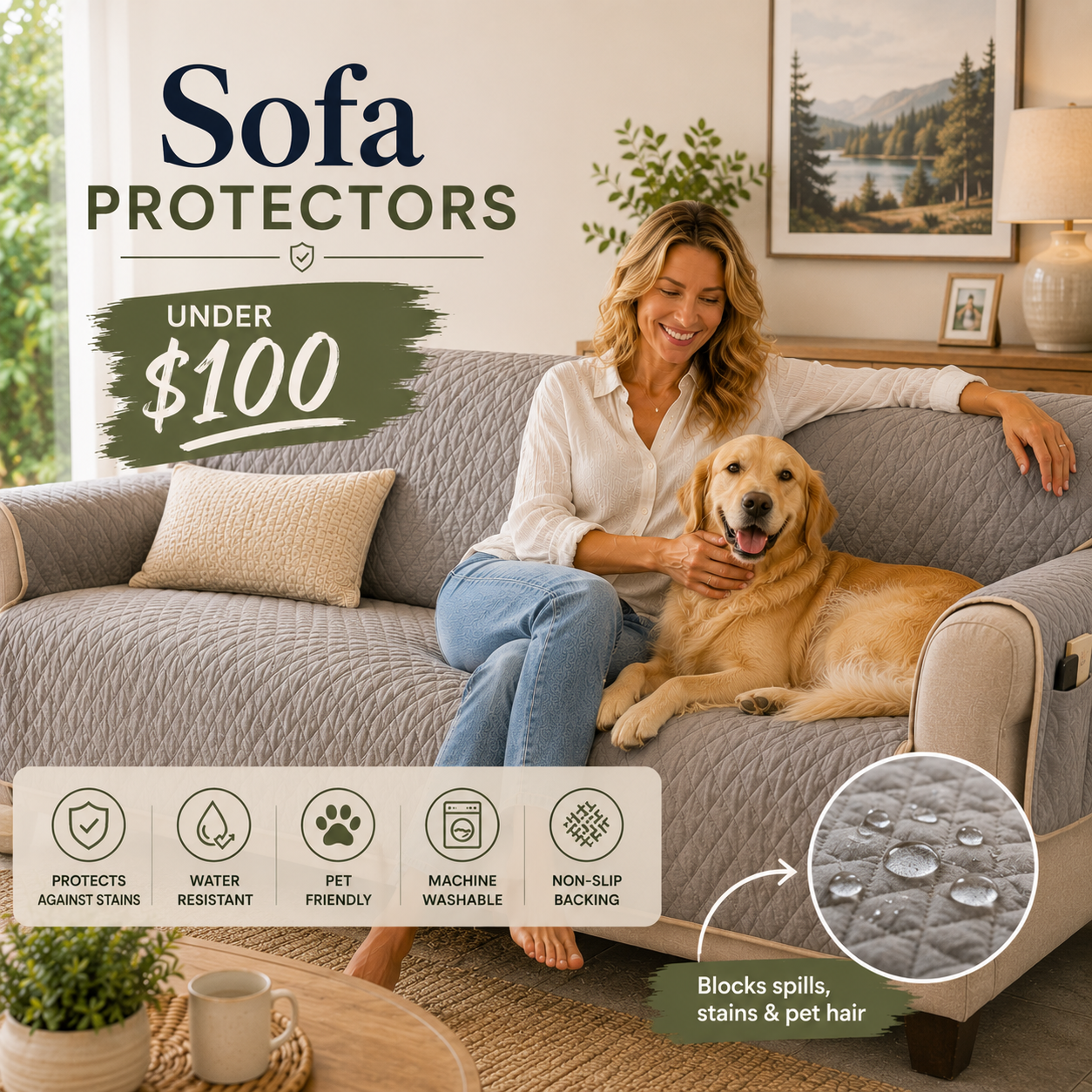
A protector-style piece may offer greater stability across the main contact areas, depending on the chair and product. Compare the Sofa Decor sofa-protector range by dimensions and intended furniture zone.
Pets, children and everyday use
For pets, consider where the animal actually sits. A cat may sleep on the back or arm rather than the seat. A dog may use the entire chair or repeatedly jump onto one side.
Covering only the high-use zone can be more practical than enclosing the whole chair. However, pet-friendly does not mean scratch-proof, chew-proof or damage-proof. A cover may reduce direct contact with the original upholstery but cannot guarantee protection from persistent claws or teeth.
For children, check that the cover remains predictable when they sit, climb or lean on the arms. Loose fabric should not form loops or long floor-level edges.
Water-resistant products may help manage a small, promptly cleaned spill, but water resistant is not the same as waterproof. Liquid can pass through seams, edges or fabric that remains wet. Only make a water-resistance claim where the individual product page supports it.
When a universal armchair cover is the wrong choice
Do not force a universal cover onto a chair when:
The chair has large wings that the product cannot accommodate.
The frame is mostly exposed timber, cane or metal.
The seat and back are separate sculptural shells.
The chair swivels or rocks and the fabric reaches the mechanism.
Controls, vents or cables would be covered.
The upholstery cover is intended to be replaced through model-specific fasteners.
The chair is antique, fragile or materially valuable.
The required appearance is a precise upholstery-like finish.
The product measurements do not match the actual chair.
A throw, separate pieces, model-specific cover or professional upholstery solution is better than an inaccurate fit claim.
Common ordering mistakes
Buying a one-seater cover without checking the shape
“One-seater” identifies capacity, not whether the chair is a tub, wingback, club, swivel or exposed-frame design.
Measuring only the seat
The outside back, wings and arms often determine whether a cover can pass over the chair.
Confusing tub and wingback covers
A rounded tub-chair cover is not designed to create space for tall wings.
Ignoring the back of the chair
If the chair sits away from the wall, check how the cover looks and closes at the rear.
Covering a swivel base
Keep the rotating base and its clearance area free of fabric.
Expecting separate pieces to look like one slipcover
Individual covers are intended for targeted zones. Visible joins are normal.
Assuming stretch fabric guarantees compatibility
Stretch provides tolerance, not unlimited reshaping. A cover still needs the correct proportions and construction.
Hiding original design features unintentionally
A full cover may conceal timber legs, piping, buttons, wings or sculptural arms. Decide whether that trade-off is acceptable before ordering.
Pre-purchase compatibility checklist
Confirm the following before buying:
I know whether the chair is a standard armchair, club, tub, barrel, wingback, high-back, accent or swivel chair.
I measured the widest point of the complete chair.
I recorded the inside seat width and depth.
I measured the full back height and width.
I measured the arms separately.
I checked whether the seat and back cushions are fixed or removable.
I identified any swivel, rocking, reclining or powered component.
I know whether I need full coverage or targeted protection.
My measurements fall within the live product range.
The product shape matches the chair shape.
I understand whether the item is one full cover or one separate piece.
I am not expecting a universal product to reproduce tailored upholstery.
The cover will remain clear of moving bases, controls and exposed mechanisms.
I have checked the current care and return information.
Frequently asked questions
Will a standard one-seater sofa cover fit an armchair?
It may fit a conventional sofa-style armchair, but not every one-seat chair. Tub, wingback, exposed-frame and swivel chairs require separate compatibility checks.
What is the best cover for a tub or barrel chair?
A shape-specific elastic cover designed for a rounded tub, club or barrel form is usually the best universal option. Match the live measurements and product images to the actual chair.
Can I use a normal stretch cover on a wingback chair?
Only when the product specifically accommodates the chair’s wings, back height and arm shape. A generic one-seater cover may flatten or fail to contain the wings.
How do I cover an armchair with wooden arms?
Use individual seat and back pieces or a throw that leaves the exposed timber visible. A full stretch cover may hang through the open frame or conceal the chair’s design.
Can I cover a swivel chair?
Yes, but the cover must remain above and clear of the swivel base. Rotate the chair fully after installation and remove the cover if it twists or catches.
Are separate armchair cover pieces sold as a full set?
Not necessarily. Sofa Decor’s Aria pieces are separate seat, back and side-rest products. Check the selected variant and quantity before ordering.
Is an armchair cover waterproof?
Do not assume so. Some products may be described as water resistant for light spills, but that does not create a sealed waterproof barrier. Check the individual live product claims.
Choose by shape before colour
The most important step in choosing armchair covers in Australia is identifying the chair accurately. A compact barrel chair, tall wingback, exposed-frame accent chair and swivel lounge chair should not be treated as the same one-seater.
Measure the widest point, seat, back, arms and base. Then decide whether a shape-specific stretch cover, separate pieces, throw, protector or tailored solution provides the most honest fit.
Compare the live Sofa Decor sofa-cover range and confirmed armchair products only after the measurements are complete. A cover that respects the chair’s shape will be easier to install, more predictable in use and more convincing in the room than a generic cover forced onto incompatible furniture.